
Updated 11 January 2023 at 15:18 IST
India's Hanle telescope in Ladakh spots comet last seen 50,000 years ago | See pics
The Indian Astronomical Observatory's telescope has spotted Comet C/2022 E3 (ZTF) which will make its closest approach to Earth in February.
- Science News
- 2 min read

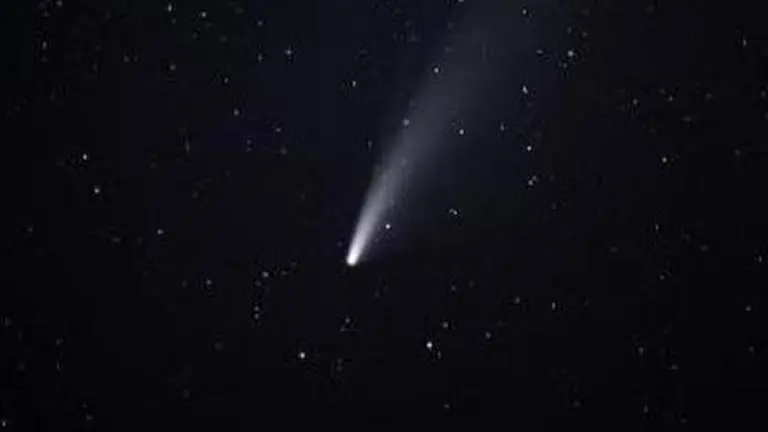
The Indian Astronomical Observatory's telescope has spotted Comet C/2022 E3 (ZTF) which will make its closest approach to Earth in February. The comet was photographed by astronomers from the Indian Institute of Astrophysics, Bengaluru using the Himalayan Chandra Telescope (HCT). The HCT is situated at an altitude of 4,500 metres from sea level in Ladakh's Hanle captured and is the highest one in India.
"Comet C/2022 E3 (ZTF) photographed by IIA Bengaluru astronomers from Himalayan Chandra Telescope at Hanle, Ladakh. This comet will pass closest to Sun on 12 Jan and may be visible to naked eye by early February. It is a very rare occasion as comet will come back after 50000 years!," the Department of Science and Technology tweeted.
Comet C/2022 E3 (ZTF) photographed by @IIABengaluru astronomers from Himalayan Chandra Telescope at Hanle, Ladakh. This comet will pass closest to Sun on 12 Jan & may be visible to naked eye by early February. It is a very rare occasion as comet will come back after 50000 years! pic.twitter.com/JyChsy6i5g
— DSTIndia (@IndiaDST) January 10, 2023
The comet is seen as a hazy green blob of light as it approaches the sun before getting close to our planet. IIA Bengaluru explained that the stars in the background of the image appear to move in a trail because of the fast movement of the comet the telescope was tracking. Photographed by astronomers Margarita Safonova, Mulchand Kurre and Bharat Chandra, the comet was observed in red, green, and blue filters and then the three images were stacked over each other.
The Insititute shared a picture of another comet that can be spotted with telescopes at this time. The picture below features the comet C/2020 V2 ZTF which was also spotted by the HCT.
Advertisement
There is a second comet that can be seen in the sky now, C/2020 V2 ZTF, which was also photographed with the Himalayan Chandra Telescope in #Hanle. @IndiaDST @lg_ladakh @utladakhtourism @srivaric @PrinSciAdvOff @PBLadakh @ddnewsladakh @dorje1974 @fiddlingstars @NirujMohan #HDSR pic.twitter.com/sWjYNo2pPL
— IIAstrophysics (@IIABengaluru) January 10, 2023
As for Comet C/2022 E3, it was discovered in March last year and is expected to be closest to Earth on February 1, per NASA. It is currently at its brightest because it will be at perihelion, meaning closest to the Sun, on January 12.
Published By : Harsh Vardhan
Published On: 11 January 2023 at 15:20 IST